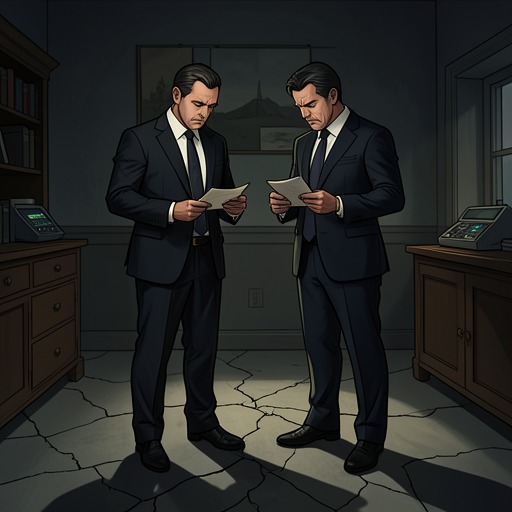
Corsican gang
Maigret and the Dead GirlThe Corsican gang is an underworld organization whose place in the case is chiefly revealed through Bianchi, suspected of leading it. Its reach emerges not through a portrait of its internal workings but through police records, a planned attempt to obtain hidden money, and the fatal assault on Louise Laboine. The account connects criminal calculation to sudden violence while leaving the gang’s wider membership and structure largely unspecified.
Leadership and Police Record
Bianchi is identified as the fellow suspected of leading the Corsican gang. His history with the police suggests both his persistence in criminal life and the difficulty of securing a lasting conviction: Maigret had arrested him at least ten times, but only once succeeded in having him jailed. That single imprisonment lasted five years. The gang’s standing in the novel is therefore filtered through a familiar adversarial relationship with the police, in which repeated arrests have not removed its suspected leader from circulation.
When Maigret orders Torrence to take several men to Big Jeanne’s flat on Rue Lepic, he expects they may find Bianchi there and warns that he is dangerous. The instruction makes the police response concrete: the suspected leader is not merely a name in an investigation but a person they expect to locate through associates and familiar addresses. The scene does not establish that Big Jeanne belongs to the gang; it shows her flat as a possible place to find Bianchi.
The Attempt to Obtain the Money
The gang’s connection to the hidden cash appears in Maigret’s reconstruction of the plan. He reasons that Bianchi could not send just anyone to the United States to approach Lukasek and ask for the money: Lukasek would expect instructions and proof of the girl’s identity. In Maigret’s account, the plan consequently depended on Louise coming to Pickwick’s Bar, where she could be identified and intercepted. This detail makes identity itself part of the criminal operation: the person sent to claim the money had to satisfy a test of recognition.
The account also places other men and a car around the attempt. Albert says that his boss had a car with Tattoo Jack at the wheel; he was not with the men who followed Louise, and says he learned the later details from them. Tattoo Jack, he adds, had fled after the incident and was probably in Marseilles. These details suggest accomplices and logistical support, but the novel does not provide a full roster or explain the gang’s hierarchy beyond Bianchi’s suspected leadership.
The Attack on Louise Laboine
The attempted theft became an assault when Bianchi tried to snatch Louise’s handbag. The car first drove past her; Bianchi then got out as she came level with it on a deserted street. He seized the bag without realizing that its chain was twisted around her wrist. Louise fell to her knees, and when she opened her mouth to scream, he struck her in the face. As she clung to him and tried to call for help, he took a blackjack from his pocket and clubbed her.
The chain changed the consequence of what may have been intended as a quick theft: instead of carrying off the bag and escaping, Bianchi was held in contact with Louise long enough for the attack to escalate. The narrative stresses the contingency of this outcome. Had the chain not caught around her wrist, Bianchi could have taken the bag and driven away; even if Louise had then gone to the police, Maigret reflects that no one might have believed her account. The object is not presented as the cause of the gang’s violence, but as an accidental interruption that made its violence visible and deadly.
Scope and Significance
The gang’s role is defined by what the investigation can establish: Bianchi’s suspected leadership, a plan tied to collecting the hidden money, men and a car involved in following Louise, and Bianchi’s attack when the bag was seized. The evidence does not support a detailed account of the organization’s membership or routine operations. Instead, it presents the gang as a criminal network capable of arranging pursuit and using force, while emphasizing how a calculated attempt to take property turned, through an unforeseen snag, into murder.